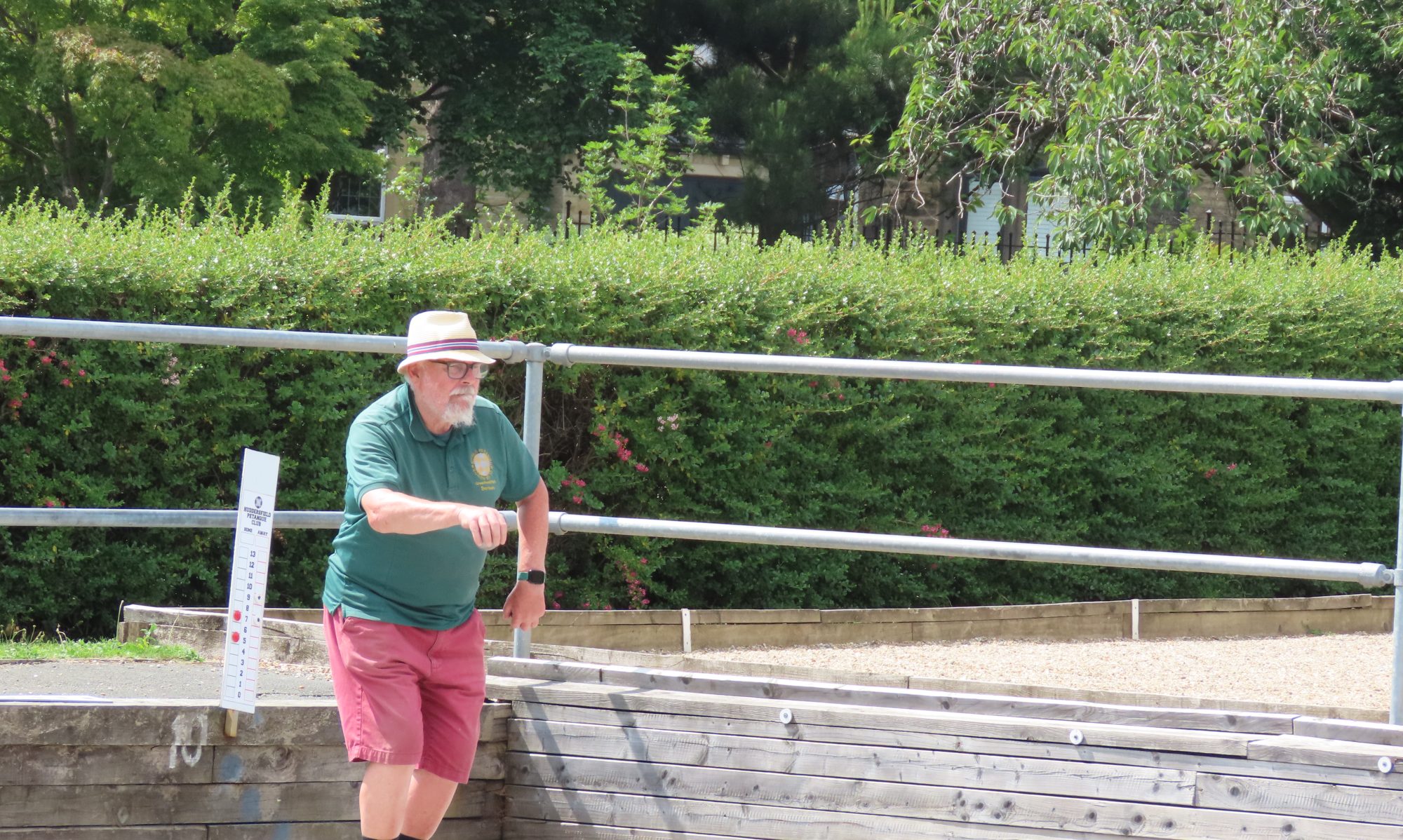
Once the jack is thrown each player has the maximum duration of one minute to play his or her boule. How does this work in practice?
Look at the rules and penalties involved and improve your time management. Click on Just a minute

Chess with steel balls in Greenhead Park

Once the jack is thrown each player has the maximum duration of one minute to play his or her boule. How does this work in practice?
Look at the rules and penalties involved and improve your time management. Click on Just a minute
It sounds so formal to have a captain for a team of 2 or 3 players. Is it really necessary or will it help the team function? We think yes.
See more at. why-have-a-captain.pdf
The game originated in France so obviously so much of its vocabulary comes from there as well. Occasionally at our club we have “talk like a Frenchman” games where everyone tries to remember their O level French from 50 years ago and fail miserably.
If you click on the link below you can see a document which has an extensive list of pétanque terms but it misses out on some of the common phrases you hear while you’re on the piste in France.
When things go well it’s common to hear Bravo! This is probably Italian but has moved into French and English and is easy to remember. A quiet bien joué (bee-ann-ju-ay) means well played and bien tiré (bee-ann-tir-ay) is good shot. A humorous modern addition when a boules takes its own meandering path to the jack is téléguidé – remote controlled.
When things go wrong the language changes. Some of these are untranslateable. Most English people know Merde and it’s easy to say. Don’t forget the very useful double merde (doo-bler-maired) and the rarely heard triple variety.
Other unhappy expletives are a mix of putain (prostitute), bordelle (brothel) and merde. On its own putain means bloody hell but combined with the other two words can mean fer cryin’out loud or ferchrissakes according to how forcefully they are spat out. Another phrase often heard just after someone has missed a shot is J’ai pas le droit which probably means Oh no I’ve missed it but could be more sinister. Maybe our French speaking readers can help out here. Translating idioms from one language to another is fraught with danger.
Finally the French hardly ever refer to the cochonnet. It’s an urban myth. They talk about le but (boo) or le petit. Cochonnet only exists in in O level French text books circa 1970.
Allez! Salut maintenant!
https://huddersfieldpetanque.com/wp-content/uploads/2020/04/french-terms.pdf
We’ve noticed from our travels playing the game that many clubs don’t run many competitions. It may be that they don’t want them or that they don’t know how to so we’ll look at how to take the first step.
Firstly competitions don’t have to be intense, day long events with huge prize funds full of top players. There’s a place for these but there’s also room for friendly competitions, short competitions, silly competitions and unusual competitions. Today is short ones.
Click here to read full article.
It’s been a long time coming but it’s likely that Kirklees (a metropolitan council area in the northern region of Pétanque England) is the most progressive council in England when it comes to Pétanque. But it’s all quite recent. Read the full article at here